
It’s getting warmer!
Bridgetown Regional High School
Hope the snow goes really fast so we can start collecting. Really looking forward to this project!
Iona Academy
Our Iona Academy grade 7 little scientists are ready for spring! We cannot wait to explore our backyard world of biodiversity. We can smell spring coming 🙂
Scarlett Heights ready and waiting for spring and the bugs to arrive!
Our grade 9 science class at Scarlett Height Entrepreneurial Academy is excited to be part of this program. We have just started our unit on ecology and we are looking forward to putting our learning to practical use.
M.C. Knoll is ready… if only the weather was.
It’s snowing and cold outside but that won’t stop the M.C. Knoll grade 5 students from doing a walk-about next week to hunt for the perfect place to set-up the Malaise trap. We look forward to blogging our experiences and discoveries!
Happy to take part in this incredible project!
Students are very excited to participate in the School Malaise Trap Program and we look forward to starting!

Congratulations to our 2015 Spring School Malaise Trap Program Participants!
Thank you to all who applied for this Spring’s 2015 version of the School Malaise Trap Program! This year, we received an overwhelming amount of applicants to the program (224 schools) from across Canada. We are thrilled with this response, and as such we hope to be able to increase the Fall 2015 program’s capacity to meet demand. It is because of your continued enthusiasm and support of the program that we have become so successful.
We are pleased to announce the following 64 schools and 6 reference sites have been accepted into the 2015 Spring School Malaise Trap Program. Congratulations to all!
2015 Spring School Malaise Trap Program Participants:
| School | Province |
| École Agnes Davidson Elementary School | AB |
| Evergreen Elementary School | AB |
| J.H. Picard | AB |
| New Horizons School | AB |
| Slave Lake Koinonia Christian School | AB |
| Spruce View School | AB |
| Cameron Elementary School | BC |
| Charles Hays Secondary School | BC |
| Citadel Middle School | BC |
| Clearwater Secondary School | BC |
| Cortes Island School | BC |
| Departure Bay Elementary Eco School | BC |
| George M. Dawson Secondary School | BC |
| Merritt Secondary School | BC |
| Nukko Lake Elementary | BC |
| Queen Charlotte Secondary School | BC |
| Suncrest Elementary | BC |
| West Vancouver Secondary | BC |
| École Précieux-Sang | MB |
| Kleefeld School | MB |
| Landmark Collegiate | MB |
| Shoal Lake School | MB |
| Belleisle Regional High School | NB |
| Florenceville Middle School | NB |
| Petitcodiac Regional School | NB |
| Salisbury Middle School | NB |
| Baccalieu Collegiate | NL |
| Jakeman All Grade | NL |
| Random Island Academy | NL |
| St. Joseph’s All Grade School | NL |
| St. Matthew’s School | NL |
| Berwick and District School | NS |
| Bridgetown Regional High School | NS |
| Chedabucto Education Centre/ Guysborough Academy | NS |
| Evelyn Richardson Memorial Elementary School | NS |
| Northport Consolidated Elementary School | NS |
| Valley Elementary | NS |
| Chesterville Public School | ON |
| Craig Kielburger Secondary School | ON |
| East York Collegiate Institute | ON |
| Gary Allan High School | ON |
| Iona Academy | ON |
| John Polanyi Collegiate Institute | ON |
| Monarch Park Collegiate | ON |
| North Addington Education Centre | ON |
| Notre Dame Catholic School | ON |
| Oakridge Secondary School | ON |
| Russell Public School | ON |
| Scarlett Heights Entrepreneurial Academy | ON |
| Silverheights Public School | ON |
| Smiths Falls Collegiate institute | ON |
| Teeterville Public School | ON |
| Wellington Hall Academy | ON |
| Woburn C I | ON |
| Woburn C I (Eco Club) | ON |
| Zion Heights JHS | ON |
| Miscouche Consolidated School | PEI |
| M.C. Knoll Elementary School | SK |
| St. Peter’s School | Sk |
| Vanscoy School | SK |
| Whitewood School | SK |
| Yellow Grass School | SK |
| J. V. Clark School | YK |
| Jack Hulland Elementary | YK |
| Reference Site | Province |
| Mount Moresby Adventure Camp | BC |
| The Riverwood Conservancy | ON |
| Camp Heildelberg Nature Centre | ON |
| Blair Outdoor and Environmental Education Centre | ON |
| Bluewater Outdoor Education Centre | ON |
| Toronto Botanical Gardens | ON |
Thank you to all who applied and congratulations to our selected participants!

Workshop: It’s a Malaise Trap!
Workshop: It’s a Malaise Trap!
Exploring Insect Identification and Trapping Methods
Date: Wednesday, March 25th/2015 Time: 9:00am-3:00pm
Why Insects?
Outdoor educators have always known that insects are amazing classroom study organisms! They are easy to collect and have a fascinating array of life histories. Insects are also important indicators of ecosystem health and are an integral part of every park, schoolyard and habitat surrounding us. Come enhance your knowledge of the world of insects with us at the Biodiversity Institute of Ontario (BIO)!
What you will learn!

This workshop is specially designed to teach outdoor educators about the Malaise trap, a tent-like apparatus used for the collection of flying insects, as well as insect identification, classification
The Biodiversity Institute of Ontario
The Biodiversity Institute of Ontario at the University of Guelph is an institute dedicated to the study of biodiversity, particularly at the species level. BIO is also the birthplace of DNA barcoding, whereby short, standardized gene sequences are used to accelerate species discovery and identification. BIO is home to several world-class biodiversity experts and entomologists who are eager to share their knowledge with you!
Workshop Information

Enrollment is limited to 30 participants.
Pre-registration is required
Registration Deadline: Friday, March 13th/2015
Registration fee is $50.00 +HST. (Please make cheques payable to The Biodiversity Institute of Ontario)
Date: Wednesday, March 25th/2015
Time: 9:00am – 3:00pm
*Light breakfast, snack & coffee/tea provided (Please inform us of any dietary restrictions)*
Lunch: Available for purchase on campus
Location:
The Biodiversity institute of Ontario
University of Guelph
50 Stone Rd. East
Guelph, ON. N1G 2W1
Pre-register:
Contact Vanessa Breton
P: 519-824-4120 x 58125
E: bretonv@uoguelph.ca
Fall 2014 Interesting Finds: Bees (Order: Hymenoptera)
Bees (Order: Hymenoptera)

Bees, like ants, are actually a specialized form of wasp. They play an important role in pollinating flowering plants. In July 2013 the world’s 20,000th bee species was officially described by a researcher from York University in Toronto. Your Malaise traps collected 6 species of bees and among those were the red-belted bumble bee (Bombus rufocinctus) and the honey bee (Apis mellifera).
The common eastern bumblebee (Bombus impatiens) is the most often encountered bumblebee across much of eastern North America. Unlike honey bees, bumble bees in the genus Bombus form colonies which last only one season. During the winter, mated female bumble bees hide in sheltered places and emerge in the spring to start new colonies in cozy places such as old mouse nests. Once her new home is tidy and her eggs are laid, the queen covers them with wax sheets for protection and incubates the eggs by lying over them for a period of time.

Currently Bombus impatiens is being reared and transported to some areas as a commercial replacement for honey bee pollination. Although introducing this species may be very helpful for the agriculture industry, there are some trade-offs as well. “Managed” pollination programs have introduced this eastern species to western North America, and in some places, such as California and Mexico, Bombus impatiens is now displacing native bee species.

Fall 2014 Interesting Finds: True flies (Order: Diptera)
True flies (Order: Diptera)
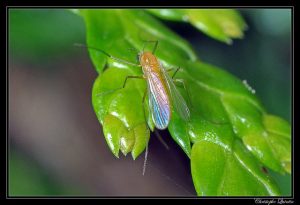
Chironomidae, commonly known as nonbiting midges, are a family of flies which can be found all over the world. A genus from this family, Limnophyes, was the most common insect during the Fall 2014 School Malaise Trap Program with 1,623 specimens being found in all 59 traps! These midges come from a very large family of insects; experts estimate that there are well over 10,000 different species of Chironomidae world-wide!
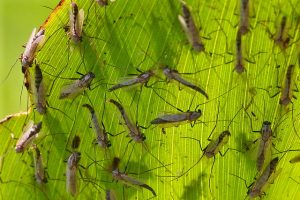
Many of these species superficially resemble mosquitoes, but they lack the wing scales and elongated mouthparts which a mosquito uses to feed on blood. The larvae and pupae of nonbiting midges are important food items for fish and other aquatic organisms. Furthermore, chironomids are important indicator organisms, meaning their presence or absence in a body of water can indicate whether pollutants are present or if environmental changes have taken place. This sensitivity to environmental changes also makes chironomids a potential source of information when reconstructing past climate. Lake sediments dating as far back as 10,000 years contain the head capsules shed by chironomid larvae during development. These head capsules allow for species identification and, because chironomid species differ in their tolerances to various environmental factors such as temperature and drought, the identity and abundance of chironomid species present in the sediment indicate the climate at that point in time.