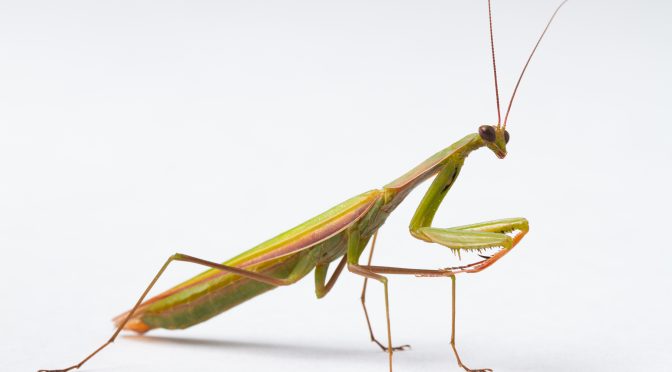
Meet Helix (the European Mantis)!
A few days ago, one of our collections technicians, Valerie, spotted a European Mantis (Mantis religiosa) while working in the Arboretum at the University of Guelph. Valerie is a fantastic photographer and has graciously shared some of her pictures of Helix with us.
As you can tell by his species name, Helix is native to Europe, Africa and Asia and was introduced to North America in 1899. The European Mantis is now found across Canada as well as throughout northern parts of the United States.

The European Mantis can live in a variety of habitats, but seems to prefer green growth and sunny areas by shrubbery or herbaceous plants.

Helix will prey on several different kinds of insects including moths, caterpillars, butterflies and bees. Here Helix is pictured munching on a cricket.

The European species comes in a wide variety of colours ranging from dark brown to bright green. Like all Mantids, the female is larger than the male, especially at the abdomen. Due to their size, females are unlikely to fly and will scare off predators by flaring their wings and raising their arms. After mating, females have been known to consume the male they reproduce with.