Week 1 Results

image

This is the amount of insects we got for the first week. It wasn’t much, but we hope to get more the second week.The area we put it in has an abundance of creatures of all different kinds (we saw a red admiral butterfly before we went to set it up!) We showed our project to a younger class in our school and they got so excited!This is a great program and all the kids in our school want to participate!

image

2nd Week of Collecting Specimens

It has definitely been a different week than last week for collecting specimens.. overall much cooler and certainly much  soggier!

J. F. Ross students in periods 1, 3 and 4 have been collecting their data on a daily basis, Mr. Neerhof’s class visited with  Dr. Steinke during the virtual BioBus tour.

Students have enjoyed visiting the trap each day, and have incorporated this hands-on study into their ecology unit.

Activities and discussions around biodiversity, ecosystem sustainability and  carrying capacity have stemmed from the experience.

Thanks so much from all of the Ross students!

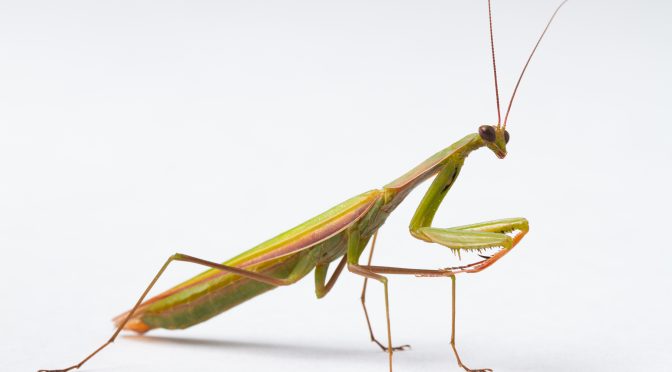
Meet Helix! (Mantis religiosa)

Meet Helix (the European Mantis)!

A few days ago, one of our collections technicians, Valerie, spotted a European Mantis (Mantis religiosa) while working in the Arboretum at the University of Guelph. Valerie is a fantastic photographer and has graciously shared some of her pictures of Helix with us.

As you can tell by his species name, Helix is native to Europe, Africa and Asia and was introduced to North America in 1899. The European Mantis is now found across Canada as well as throughout northern parts of the United States.

VLB_Photo_140930_IMG_9067

The European Mantis can live in a variety of habitats, but seems to prefer green growth and sunny areas by shrubbery or herbaceous plants.

VLB_Photo_140930_IMG_9126

Helix will prey on several different kinds of insects including moths, caterpillars, butterflies and bees. Here Helix is pictured munching on a cricket.

VLB_Photo_140930_IMG_9089

The European species comes in a wide variety of colours ranging from dark brown to bright green. Like all Mantids, the female is larger than the male, especially at the abdomen. Due to their size, females are unlikely to fly and will scare off predators by flaring their wings and raising their arms. After mating, females have been known to consume the male they reproduce with.

Anxiously Awaiting Samples

The Collections Unit at the Biodiversity Institute of Ontario (BIO) is extremely excited that we’ll soon be helping out with this fall’s edition of the School Malaise Trap Program (SMTP).  We are anxiously awaiting the samples to arrive next week, when we finally get to do our part in the ‘DNA barcoding’ process.  Our unit is basically responsible for all the steps leading up to the lab work – we collect specimens in the field, sort the trap samples and specimens, then database, photograph and tissue sample.  That small piece of tissue (or the entire specimen for very small organisms) is then handed off to the laboratory where that unit is responsible for DNA extraction, amplification of the DNA barcode region, and finally DNA sequencing. For the SMTP, we’re getting hundreds of young biologists helping with the field collection, and we can’t wait to see what they trapped in their schoolyards.  Who knows – maybe they’ll collect species we’ve never found before and they’ll have to give us advice!

Stay tuned for an update from us next week when the samples have arrived and we’re ‘forceps-deep’ in all the great trap samples collected through the SMTP.

A Few More

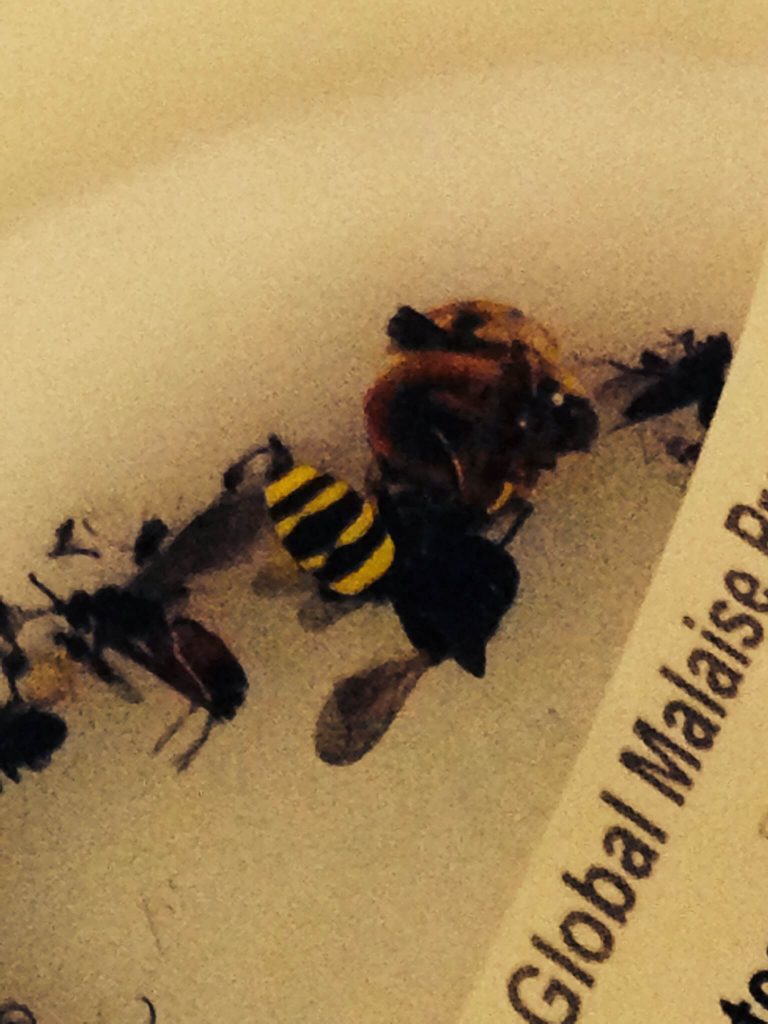
MOTH AND BEE–About 5-7 more insects were caught yesterday while it damper and colder at St. Ignatius of Loyola. Although it was a slower day,  new additions include: a bee and a small type of moth. The moth is something we have not had before so the variety has been really interesting for us to see.

IMG_0647 (1)

St. Paul’s Malaise Trap

Hello BIO! We were late on yesterday’s blog but this is a catch up.  The catch volume so far this week is at about 2 it’s going at about the same pace as last weeks catch volume.  Today is a very wet day so that hopefully will bring in a new species of insect! We will update you tomorrow on how it is going.

This blog was written by Daniel & Liam

C.C. Mr. E? Flickr Creative Commons
C.C. Mr. E?
Flickr Creative Commons

First Week Review

As the experiment has progressed over this first week the results have been disappointing. The first week bottle was removed and much to the participants surprise there was an incredible lack of biodiversity. This lack of a large sample size is extremely surprising because of the amount of plant matter in the courtyard. The trap was assessed on the second day to make sure any issues that may affect the experiment were taken care of. Spider webs were cleared off the bottle but even after that was taken care of the results were still lacking.

Though the lack of a large sample size is surprising an experiment conducted last year heeded some of the same results.  Students made Sticky Traps last year to examine biodiversity in the courtyard and they too were surprised by the underwhelming numbers. They were especially surprised because a school nearby had great results.

This lack of biodiversity does make sense in comparison to the other high school because of a few reasons. For one thing the neighbouring school backs on to a river where Richview does not. Also Richview is situated by the intersection of two major streets where the other school is only bordered by one street. Since Richview is only one kilometre away from a golf course, the chemicals used to maintain those grounds may be affecting the biodiversity at the school.

This lack of biodiversity is concerning and should be continually monitored in the future.