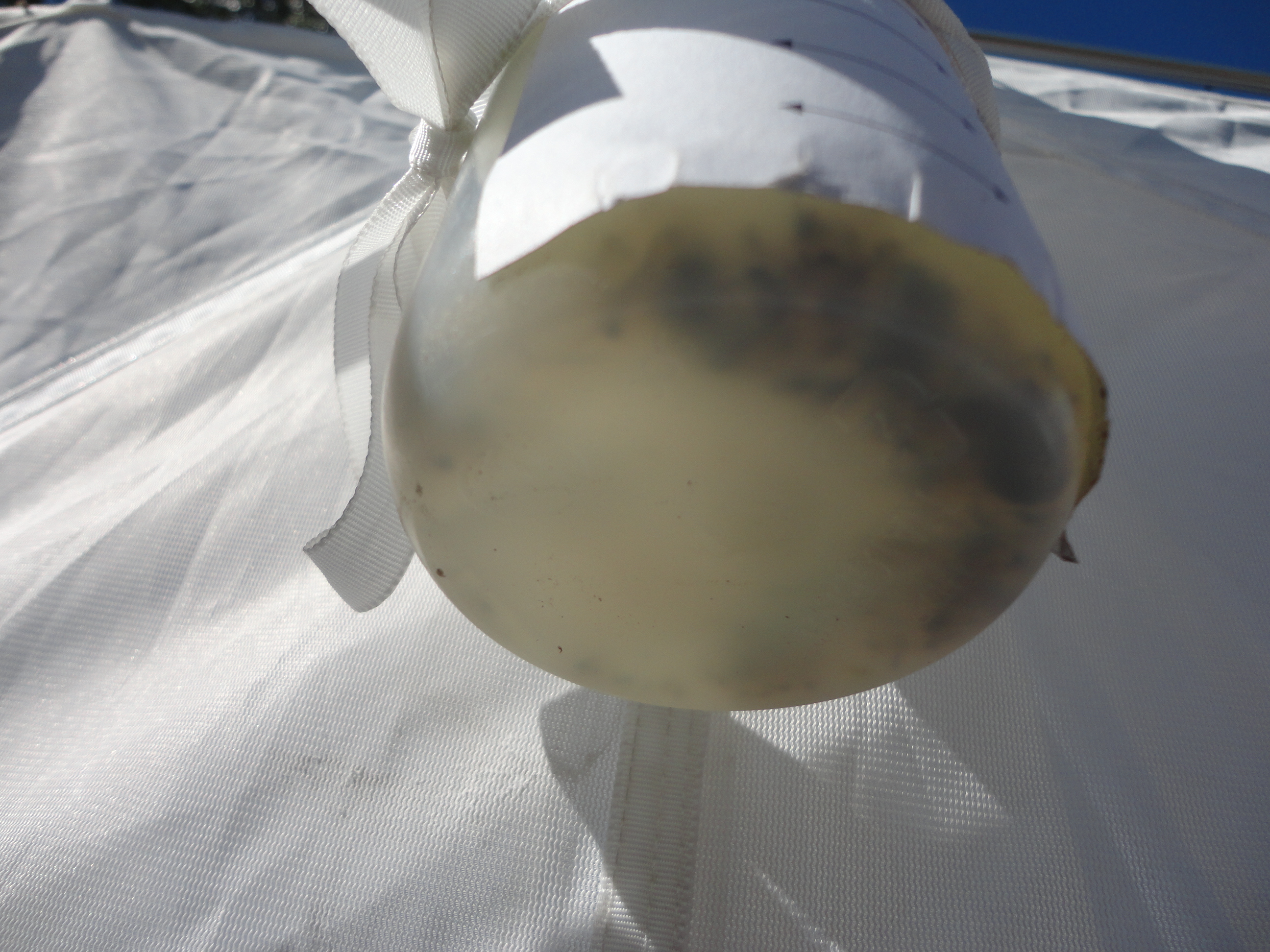
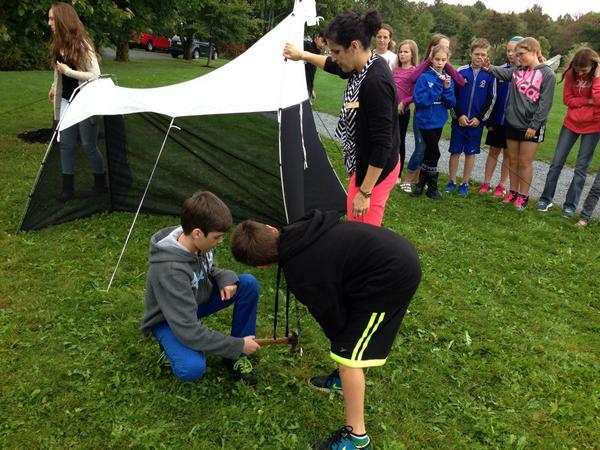
Parker, Sam and Simba checked the trap today and realized that there were quite a few bugs in the trap, but they were all bunched up in the back. When they evened it all out it rounded up to about a 1 on the chart. There were also bugs floating on the surface. The amount was up quite a bit higher than yesterday.
St. Paul Elementary School is located in South Burlington, Ontario. Our trap has been deployed in the back of the schoolyard in a field where the students play during recess. One side of the field is adjacent to houses, another side has a bike path, and the third side has a track. Today was the third day that we monitored the trap.
Currently we have a catch volume of about 1.5. We have been very excited to check our collection bottle everyday. It contains a lot of very small flying insects, and at least one wasp and spider.
The experiment is up and running at Richview Collegiate Institute. The trap has been set up in the school’s central courtyard. The students have high hopes for the findings in the experiment since the courtyard has not been weeded since June. In order to create awareness about the project an announcement was read in the morning after the national anthem and information tables were set up and manned during the lunch hour. Over the course of the day three classes were brought into the courtyard to discuss the trapping process. They discussed the purposes, method, and potential uses for the experiment and the trapping process. It was overall a successful start to Richview’s experiment.
Day 2
The experiment has sparked interest throughout the school. Many students have been very curious and have dropped by the courtyard to see the trap and observe what is happening. Two more classes have been taken to see the trap. The experiment provides great learning opportunities and has been used already to discuss method and biomolecules. Daily observations are being taken now to ensure accuracy in the results. The Biology department is excited to see what the future holds for the experiment.
St. Ignatius of Loyola Catholic School is excited to report that over 16 organisms were caught in the Malaise Trap today! New additions include: a bee, a small grasshopper, quite a few black flies, and mosquitoes. Take a look:
Hello there, my name is Alex and I am from Jack Chambers Public School. My class and I were pleased today to go out to our Malaise Trap to find many bugs captured. A classmate and I also witnessed an insect fly into the trap when we were out this morning. We’re very lucky to have the Malaise Trap where it is at the moment. It is about a minute walk from our school, and is located by a pond just off the boundaries of our school yard. We’ve gone out every day for the past 3 days. We plan to continue to go out everyday for as long as we have the Malaise Trap. Even though today was our third day going out we have only captured a days worth of insects due to our epic fail (our bottle fell off during the first day). We will make sure to get more bugs especially with the new bottle that we’re getting. Thank you for the cool trap!
Vanessa here! Today Emily and I went out to change the bottle on the Malaise trap that we have set up in front of the Biodiversity Institute of Ontario (BIO). We have had this trap out all summer and mainly use it for educational purposes, such as teaching school groups about insect trapping methods. The last time we changed the bottle was approximately two weeks ago and we were thrilled to see that the bottle was quite full!
Emily and I were quite curious about what we caught, so we decided to take a sneak peek. Peering into the bottle, we noticed an abundance of a large mosquito-like insect, commonly called a crane fly.
Crane flies come from the family Tipulidae and there are over 4,000 species found worldwide. Although they look like large mosquitoes, crane flies will not bite animals or humans. Crane flies will feed on nectar, or they will not eat at all; most adult crane flies will only mate then die. Because many species of crane flies are quite large and very abundant, they are easily preyed upon by birds, mammals, fishes, and other vertebrates, as well as by spiders and predacious insects.
C.C. Derek Parker Flickr Creative Commons
We are excited to hear about what you caught in your traps!
We are happy to be participating in the study again this year! Three classes of grade 9 students taught by Ms. Bender and Mr. Neerhof are studying the importance of biodiversity in sustainable ecosystems. The trap was deployed last Friday, with the collection bottle attached this past (very chilly) Monday morning. We have few specimens to report, and we are hoping that the nice weather this week contributes to more insect activity.
Great set up yesterday, however we have very few insects collected. The set up is on a grass patch near the classroom. Students predict that we will not get much insect collection at this site due to the lack of vegetation.