Tous les articles par SMTP Team

2014 Fall SMTP Interesting Finds: Spiders and their relatives (Class: Arachnida)

Spiders and their relatives (Class: Arachnida)

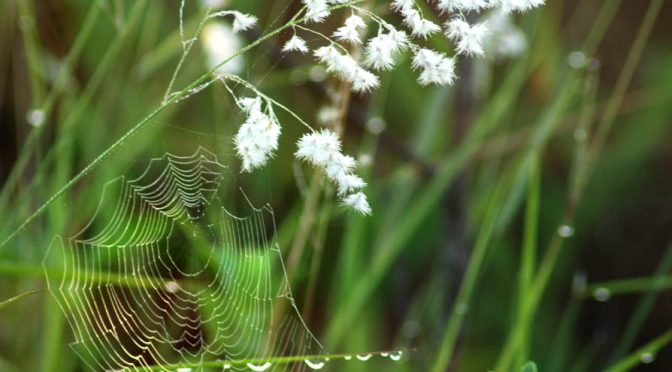
While Malaise traps are most useful for capturing flying species, 69 species collected in the Fall School Malaise Trap Program were spiders which certainly don’t fly! These 69 spider species belonged to 57 different genera of 21 families – a very diverse group! Westside Secondary School in Orangeville, Ontario collected the greatest number of spider species with 14.

https://www.flickr.com/photos/88693702@N02/8095124648/in/photolist-
Cellar Spider Sp.

One very interesting find of the Fall program was the spider species Pholcus manueli which was collected at Glendale Secondary School in Hamilton, Ontario and represents the first record of this species from Canada! Pholcus manueli is a cellar spider, belonging to the family Pholcidae. Cellar spiders are often confused with harvestmen (order Opiliones) and share the common name of daddy longlegs. Cellar spiders and harvestmen are rumoured to be some of the most venomous animals in the world but they are, in fact, harmless to humans. Cellar spiders typically live indoors where they build webs and hang upside down, waiting for their insect prey.

Cellar spider (Pholcus manueli)

In previous years, occurrences of Pholcus manueli were restricted to Asia and to the southern regions of the United States. However, within the past five years, the range of this species has expanded to the midwestern United States, particularly Ohio, where it has taken the place of another invasive species, Pholcus phalangioides, and become very abundant in barns, sheds, and basements. The collection of this species in Hamilton with the School Malaise Trap Program suggests that it is continuing to spread northward, potentially due to climate change. The quick spread of Pholcus manueli may seem surprising particularly when you consider that this species is not known to disperse through ballooning, where a spider produces a ‘parachute’ out of silk threads that can carry it in the wind for long distances. However, this species may be able to disperse long distances through phoresy, where one animal attaches to another, perhaps a mammal or bird, for transport. Can you think of other ways that this spider species could have arrived in Canada?

Check out our Fall 2014 Detailed Program Report here!

Fall 2014 SMTP Results Have Been Issued!

PicMonkey CollageThe results are in for the Fall 2014 School Malaise Trap Program and they are truly remarkable! This Fall marked the first nationwide offering of the program, with students from across Canada exploring the biodiversity in their schoolyards and discovering how we can use DNA barcoding to inventory life on our planet. In all, 2,479 students from 92 classrooms, 59 schools, 46 cities, and 6 provinces and territories participated in the program. The 59 Malaise traps collected specimens from September 22 to October 3.
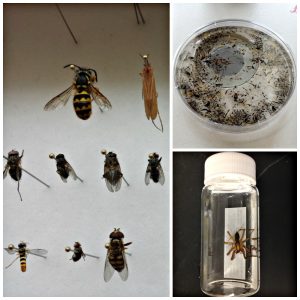
The 59 traps on average collected 1,034 specimens for the collecting period. Our staff sorted 61,052 specimens and 13,846 of these primarily insect specimens were barcoded. The DNA barcodes allowed us to determine that 3,402 species were collected over the two week period of the program, more than twice as many as any of our previous School Malaise Trap Programs! We are excited to report that 324 of these species were brand new to our DNA barcode library (BOLD), representing a significant contribution to the International Barcode of Life project.

To view the full results of the program, including an overall detailed program report, full species list, and full image library, please click here. You can also access our « winners » ranking sheets here.

PicMonkey Collage1Not only were your collection numbers astounding, your species discoveries were even more exciting! Over the next few weeks the SMTP team will be highlighting your discoveries through our blog posts and we hope that you will do the same! First off, let’s get a sense of what you collected in your Malaise trap.

Most of the 3,402 species that you collected were arthropods — invertebrates with a hard external skeleton. If you look at the pie chart below, you’ll notice that many (36%) of the species were flies (scientific name: Diptera). Some groups of flies were particularly diverse; there were 285 species of midges (Chironomidae), 116 species of fungus gnats (Sciaridae), and 95 species of scuttle flies (Phoridae). In addition, just like Fall 2013 and Spring 2014 programs, the most abundant species was a midge. After flies, the next most species diverse group was bees, wasps, and ants (Hymenoptera), followed by the true bugs (Hemiptera). Most of the species in these groups have wings, so it’s not surprising that they were collected in your Malaise traps. However, you also collected some groups that don’t fly such as springtails (Collembola), spiders (Araneae), and snails (Stylommatophora).

Fall 2014 SMTP Detailed Program Pie Chart


Stay tuned for our Fall 2014 interesting species discoveries!

« Why We Kill Bugs – The Case For Collecting Insects » – Greg R. Pohl

An array of pinned specimens ready to be sampled for DNA barcoding

One of the main questions that we receive from educators who are participating in the School Malaise Trap Program is « how do I discuss the ethics of insect collection and study with my students? » This is an excellent question which we are hoping to address during this blog post.

https://www.flickr.com/photos/open-library/4818584327/in/photolist-8kNvf8-8kRKK7-o5TSN1-dX1avq-e3sKsB-f62tdZ-9Q7yUA-fr4amm-f62kZg-q629Xh-bNgZMX-e6jZ8w-8oxMHi-f61XCX-2frJ1-fj3ajL-f6fNtA-a6zUSt-7A5Xha-ggDsB7-dWGLHq-dWGLb7-5hS1rF-e6jZ2o-e2KWgA-6n7DuR-46PRKe-fiMWwK-f61StK-f61xAr-UguC-q5HrBz-pNuTQA-f62sWp-f6gLkU-fj39BN-e6egtz-f62jtT-eWCch6-f6fRLw-f6gET3-f62vJB-f6gEAw-fqNSKP-fr49dy-fr4aaJ-e7LBUP-f6fRxb-bznjeq-fiMWkH

Upon researching this topic, we came across an excellent resource titled « Why We Kill Bugs – The Case For Collecting Insects » by Greg R. Pohl. In his work, Pohl outlines several reasons as to why insect populations are resilient to collecting. Furthermore, he discusses the necessity of collecting insects for a range of purposes including taxonomy and diagnostics. He also takes the time to discuss insect conservation, the difference between insects and other animals, and the extensive need for both « amateur » and « professional » insect collectors.

His work speaks to the many ethical questions surrounding the collection and study of insects during the School Malaise Trap Program. We hope that this paper will assist you while facilitating this important discussion with your students!

Why We Kill Bugs – The Case For Collecting Insects (PDF)


BIO is heading to STAO: Join Us In Inspiring Innovation!

Banner400Each year, the Science Teacher’s Association of Ontario hosts an interactive and educational three day STEM conference in Toronto for elementary and secondary teachers from across Ontario. This year, the Biodiversity Institute of Ontario’s (BIO) Education & Outreach Team will be in attendance and will be presenting two workshops regarding the School Malaise Trap Program (Friday, Nov. 14th, 3:45-4:45pm – Session #2510) and DNA Barcoding applications for the classroom (Thursday, Nov. 13th, 8:30 – 9:30am – Session #1013). We are extremely excited to be able to participate and contribute to such a passionate community of STEM educators!

This year’s STAO conference theme is « inspiring innovation » and was chosen in order to « help science educators in Ontario better understand the significance of STEM education and how it can prepare students for a rapidly changing global world. » We could not have said it better ourselves, as we too have a deep connection to these values!

DNA Barcodingibol2, a genetic technique used to identify species, is a relatively new addition to the Ontario curriculum. Its applications are far reaching, and astounding initiatives have been created through utilizing this technology – most notably, the International Barcode of Life project (iBOL). This project is the largest biodiversity genomics initiative ever undertaken and aims to create a barcode reference library (BOLD) of all the species found on earth.

LifeScanner
LifeScanner Kit

Feeling inspired and innovative yet? We thought so! The best part about the International Barcode of Life project is that anyone can contribute to it, as well as access the data (found online at BOLD). Classroom projects and programs ranging from DIY lab studies, participating in the School Malaise Trap Program, and submitting a LifeScanner kit for analysis are some of the many ways that students can contribute valuable data to iBOL!

Through these innovative citizen science initiatives, BIO hopes to inspire students to contribute to, and prepare for, a bioliterate future.  Although we live in a fast-paced and rapidly changing world, DNA barcoding is a key piece of technology that will help us to slow down and truly assess, protect, and monitor all levels of biodiversity found around us.

Announcing the #SMTPselfie Winners!!

LifeScanner
LifeScanner Kit

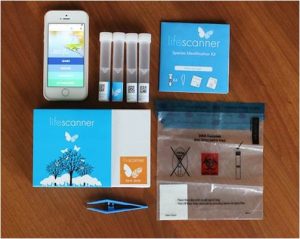
We are pleased to announce the winners of our #SMTPselfie contest! Thank you to all who entered, and don’t worry…we’ll have another contest as soon as you receive your School Malaise Trap Program results! The winners for the #SMTPselfie contest will receive a LifeScanner Kit which is a new tool for exploring the biodiversity around you. This species identification kit will allow students to fill four vials with a whole organism or a piece of tissue and send it back to BIO for analysis!

And without further ado…the winners of the #SMTPselfie contest are:

1) Jack Chambers Public School

2) St. Charles College

3) Forest Avenue Public School

4) St. Paul Elementary School

5) Monsignor Doyle Catholic Secondary School

Congratulations to the winners, and a big thank you to all who participated! The LifeScanner Kits have been mailed and are on their way to you!

We look forward to sharing the School Malaise Trap Program results with you soon!

Standardized Sampling at its Finest!

Take a look at how the BIObus crew sets up a site for Standardized Sampling! This was taken at a rainforest site in Pacific Rim National Park Reserve in 2014. Watch Kate, Joey, Graham, and Danielle deploy a Malaise trap, flight intercept trap, pan traps, and pitfall traps before finally sweep netting the area for 5 minutes and settling down to aspirate all the insects.

Step 1: Sorting and Imaging your Samples

Hello School Malaise Trap Program participants,

So far, our Collections team here at BIO has provided you with amazing first-hand accounts of what happens to your specimens once they arrive at our facilities to be DNA barcoded. During this blog post, we are going to show you what our facilities and the DNA barcoding process looks like.

Below, you will find an educational video which explains the first steps towards ultimately obtaining a DNA barcode – sorting and imaging your specimen.

Stay tuned for our next video which will showcase our lab and sequencing processes!

Samples are Arriving at BIO!

Hello School Malaise Trap Program Participants!

We are happy to say that we have received almost all of your Malaise trap samples for the Fall 2014 program! The rest of the samples are on their way, and we can’t wait to see what you have all collected.

Once your samples arrive at BIO, they go straight to our Collections unit, where they will be sorted by insect Order. As you can see from the photo below, this can be quite a long and meticulous process.

20141008_124327

Stay tuned for an update from our Collections unit soon!

Meet Helix! (Mantis religiosa)

Meet Helix (the European Mantis)!

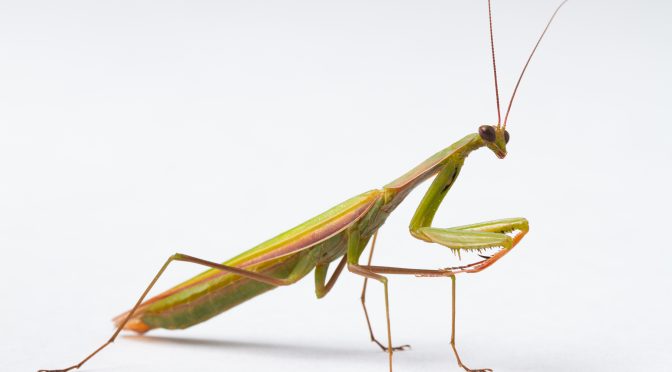
A few days ago, one of our collections technicians, Valerie, spotted a European Mantis (Mantis religiosa) while working in the Arboretum at the University of Guelph. Valerie is a fantastic photographer and has graciously shared some of her pictures of Helix with us.

As you can tell by his species name, Helix is native to Europe, Africa and Asia and was introduced to North America in 1899. The European Mantis is now found across Canada as well as throughout northern parts of the United States.

VLB_Photo_140930_IMG_9067

The European Mantis can live in a variety of habitats, but seems to prefer green growth and sunny areas by shrubbery or herbaceous plants.

VLB_Photo_140930_IMG_9126

Helix will prey on several different kinds of insects including moths, caterpillars, butterflies and bees. Here Helix is pictured munching on a cricket.

VLB_Photo_140930_IMG_9089

The European species comes in a wide variety of colours ranging from dark brown to bright green. Like all Mantids, the female is larger than the male, especially at the abdomen. Due to their size, females are unlikely to fly and will scare off predators by flaring their wings and raising their arms. After mating, females have been known to consume the male they reproduce with.